
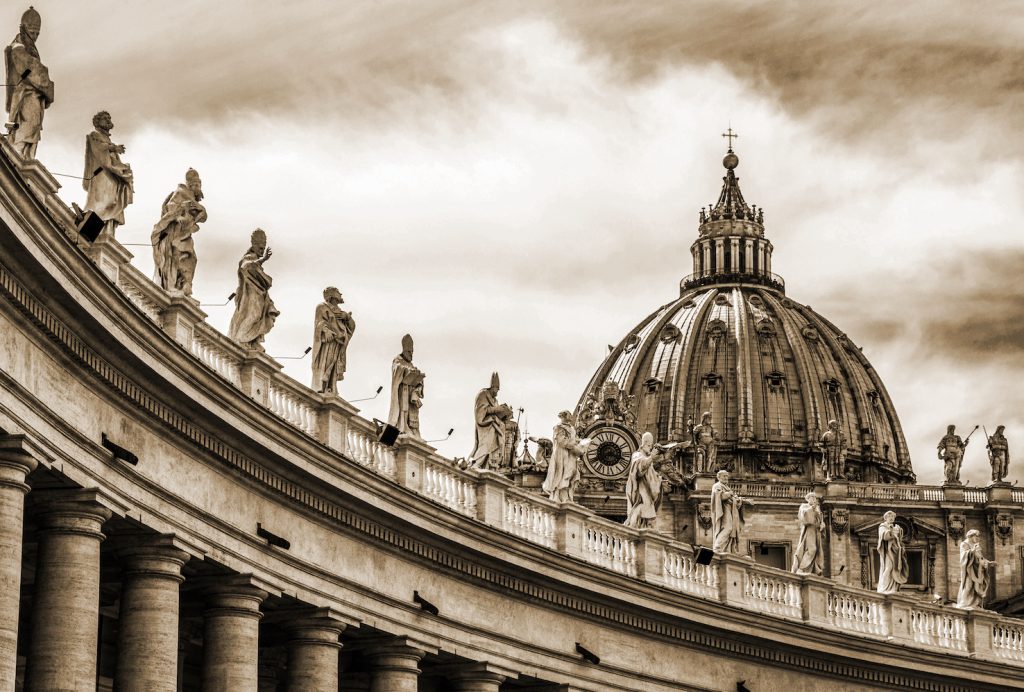
The PIETRA project (ERC CoG 101001478), run by Prof. Anne O’Connor, presents “Global Catholicism and Language” – An Exploratory Workshop. The workshop will take place on June 8-9, at the University of Galway.
From a multidisciplinary background, the workshop will address the concept of Global Catholicism, its usefulness and applicability to different disciplines. Discussants will consider the relationship of language and translation to this concept, the communicative aspects of Global Catholicism, the role of technology and religious orders in a global religious world and historical patterns in Global Catholicism. The workshop will question how a concept such as ‘the global’ helps in understanding a transnational religion and will further ask what forms of textual, material, and cultural translation take place in a global religion and enable its functionality.
Day 1 – Monday, June 8
10:30 | Tea/Coffee and Welcome (Anne O’Connor)
11:00–13:00 | Session 1: Concepts and Applications
Massimo Faggioli – “Global Catholicism”
Massimo Faggioli is professor in ecclesiology at the Loyola Institute at Trinity College Dublin (Ireland). He lived/studied/worked in Ferrara, Bologna, Turin, Rome, Tübingen, Quebec, Boston, Minneapolis, Philadelphia, and Dublin (Ireland). He received his doctorate in 2002. He did research in the John XXIII Foundation for Religious Studies in Bologna between 1996 and 2008, when he moved to the USA. Between 2016 and 2025 he was professor in the Department of
Theology and Religious Studies at Villanova University (Philadelphia, USA). He is member of the steering committee for the project “Vatican II: Event and Mandate” for a 12-volume intercontinental commentary of Vatican II. In 2023 he has been elected to the board of editors of the international journal of theology Concilium. He was founding co-chair of the unit “Vatican II Studies” for the American Academy of Religion between 2012 and 2017. He is contributing writer for Commonweal magazine and for the Italian magazine Il Regno. His books and essays have been published in more than ten languages. Among his recent publications: The Liminal Papacy of Pope Francis. Moving Toward Global Catholicity (2020); Joe Biden and Catholicism in the United States (Bayard 2021); The Oxford Handbook of Vatican II, co-edited with Catherine Clifford (2023); Theology and Catholic Higher Education: Beyond Our Identity Crisis (2024); Da Dio a Trump. Crisi cattolica e politica americana (2025). He is co-author of Global Catholicism: Between Disruption and Encounter (2024) with Bryan Froehle, with whom he co-founded and co-edits the series “Studies in Global Catholicism” for Brill Publishers https://brill.com/display/serial/SGC
Anne O’Connor – “Translation and Global Catholicism”
Anne O’Connor is Established Professor in the School of Languages, Literatures and Cultures at the University of Galway, Ireland and a Member of the Royal Irish Academy. She is Principal Investigator (PI) of the ERC Consolidator funded PIETRA project and leads a team of 7 researchers working on religious translation in the Catholic Church (https://pietra.universityofgalway.ie). She is the Director of the Emily Anderson Centre for Translation Research and Practice at the University of Galway and PI in the HEA-funded MISTE project on sites of translation in contemporary Ireland. She is the author of Translation and Language in Nineteenth-Century Ireland: A European Perspective (Palgrave, 2017) and some recent publications include: “Media and translation: historical intersections”, Routledge Handbook of Translation and Media (2022); “Women translators and paratextual authority: The frameworks of religious translation”, Parallèles (2022); “Translation and Religion: Issues of Materiality”, Translation Studies (2021); and the edited collection Tangible translation: Migration and materiality (2022). She is the author of the forthcoming volume (with Raluca Tansescu) Translating Global Catholicism in a Digital World (Routledge).
Respondent: Anna Dimas Furtado.
14:30–16:40 | Session 2: Global Catholicism and Communication
Andre Joseph Theng
Andre Joseph Theng is a sociolinguist and discourse analyst. He received his PhD at the University of Edinburgh. His project considered Catholic discourses on social media from the English-speaking Catholic world. He previously completed his MPhil at the School of English, The University of Hong Kong in the field of the linguistic landscape. He is broadly interested in sociolinguistics online and offline, religious discourses, and critical dimensions to language in urban contexts. Recent journal publications are in Linguistic Landscape, Signs and Society, and Discourse, Context & Media.
Paul Soukup
Paul Soukup, S.J., teaches courses in technology and communication, and does research on religious communication. He has authored or edited a number of books and works with both the
U.S. Conference of Catholic Bishops and the American Bible Society on communication issues. Paul A. Soukup, S.J., has explored the connections between communication and theology since 1982. His publications include Communication and Theology (1983); Christian Communication: A Bibliographical Survey (1989), Media, Culture, and Catholicism (1996), Mass Media and the Moral Imagination with Philip J. Rossi (1994), and Fidelity and Translation: Communicating the Bible in New Media with Robert Hodgson (1999). In addition, he and Thomas J. Farrell have edited four volumes of the collected works of Walter J. Ong, S.J., Faith and Contexts (1992-1999). These volumes have led him to examine more closely how orality-literacy studies can contribute to an understanding of theological expression. He has published a book of Biblical meditations on communication, Out of Eden: 7 Ways God Restores Blocked Communication (2006) and edited a collection of essays applying Ong’s thought, Of Ong & Media Ecology: Essays in Communication, Composition, and Literary Studies (2012). Fr. Soukup currently serves on the Board of Trustees of the American Bible Society and recently served on the Board of Trustees at Loyola University of New Orleans.
Respondent: Menna Mansi
Day 2 – 9 June
10:00–12:00 | Session 3: Technology and the Digital in a Global Religious World
Victoria Dos Santos
Victoria Dos Santos holds a degree in Communication Sciences from the Andrés Bello Catholic University (UCAB) in Caracas, Venezuela, as well as a master’s degree in Journalism from the University of Barcelona (Spain) and Columbia University (USA). In 2022, she earned a Ph.D. in Semiotics and Media from the University of Turin, Italy. Her research interests include digital religion, neo-animism, contemporary paganism, semiotics, and media studies. Currently, Dr. Dos Santos is a Marie Skłodowska-Curie postdoctoral fellow at the Blanquerna Observatory (Barcelona), where she is developing the project DRIVEN, which explores digital avatars, religion, and embodiment in immersive virtual environments. From August 2024 to December 2025, she was also a postdoctoral fellow at the Pontifical Catholic University of São Paulo (PUC-SP), in São Paulo, Brazil. Her research proposal focused on digital religion in Brazil and on how different religious traditions manifest in immersive virtual platforms. Additionally, she has held a research position at the ZRS Koper Institute for Philosophical and Religious Studies (Slovenia) since 2022, and is currently involved in the project Constructive Theology in the Age of the Anthropocene and Digital Culture.
Raluca Tanasescu – “How Global is Global Communication in the Catholic Church?”
Raluca Tanasescu (PhD University of Ottawa) is a postdoctoral researcher at the University of Galway’s Digital Humanities Research Centre and currently serves as the Chair of the Multilingualism and Multiculturalism Committee with the Alliance of Digital Humanities Organizations. Previously, she worked on multilingual digital communication as part of the ERC-funded PIETRA project. Her scholarly work is situated at the nexus of translation, new media, computational humanities and religious studies. Recent publications include: “The Eighteenth-Century Debate on Electricity: A Multilayered Computational Perspective” (MIT Press 2025); “Computational Rifts: Parsing the Context of Early Modern Natural Philosophy” (Cambridge UP 2025); “Translation Studies and Digital Humanities” (Routledge 2025); “Reimagining Translation Anthologies” (OA, Routledge 2024); “Literary Translation on Digital Platforms” (The Translator 2024). She is co-author, with Anne O’Connor, of Translation, Religion and Social Media: Global Catholicism in a Digital World (Routledge, forthcoming).
Respondent: Tianyue Liang.
14:00–16:00 | Session 4: Religious Orders and Globalism
Conor McDonough
Conor McDonough, OP, is a doctoral student working on the Letters of St Paul in Early Irish Christianity. His research aims to offer a comprehensive treatment of the Irish tradition of Pauline exegesis, including an edition of an important commentary: the Pauline section of the commentary on the whole Bible known as ‘Pauca Problesmata’ or the ‘Irish Reference Bible’. He previously studied at University of Fribourg, Switzerland (2015-8, MTh, STL); Maynooth University (2011-4, BA in Philosophy and Latin); Cambridge University (2003-7, BA in Natural Sciences and Theology). He has worked as an interpreter for the Dominican Order.
Alison Forrestal
Alison Forrestal is Head of the School of History and Philosophy at the University of Galway. Her primary research expertise lies with the Discipline of History’s Religion and Society Research Area, but also with the Research Areas of Justice and Activism and Ireland in Global Context. She is a specialist in the early modern history of religion, with particular interest in the social, political and cultural history of the Catholic Reformation in France and Ireland. She has completed major projects on seventeenth-century religious reform and activism, clerical culture and mission, which have resulted in three monographs and many articles and essays. Most recently, she published her third monograph with Oxford University Press: Vincent de Paul, the Lazarist Mission, and French Catholic Reform (2017). She is an elected Member of the Royal Irish Academy (MRIA), and since January 2022, Co-Director of the Centre for the Study of Religion at University of Galway.
Respondent: Chris Tanasescu.